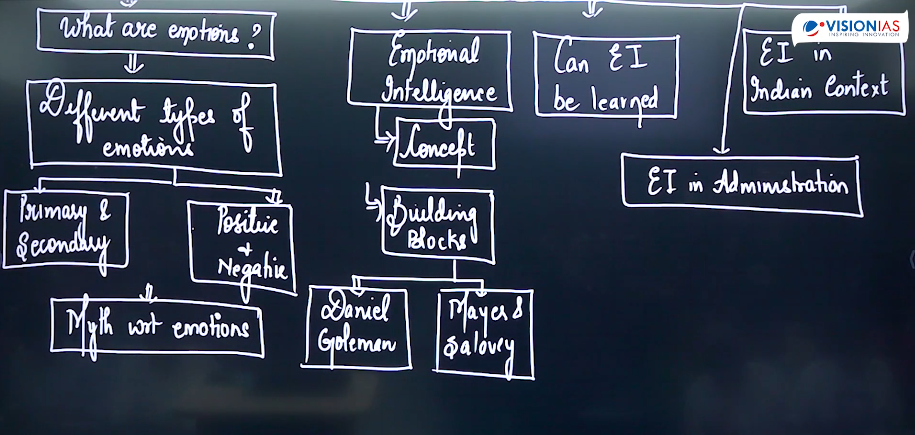
What is emotion?: personal experience which is complex interplay b/w 3 variables:
- situation
- cognitive
- physiological
Types of emotions
- primary
- direct response to situation
- secondary
- response to primary emotion
- +ve
- feel good
- love, joy, happiness
- MAY NOT ALWAYS LEAD TO POSITIVE RESULT
- -ve
- feel miserable, lower confidence
- hate, jealousy, greed, lust
Myths about emotions
- distractions
- arbitrary behaviour
- dilutes rationality
- obstructs objective decision making
- -ve impact on efficiency of any org
- eg. glass ceiling
Emotions help us in:
- motivation
- build trust
- constructive feedback
- improve interpersonal relations
- strengthen social capital
improves efficiency of org
Emotional Intelligence
- ability to identify, use, understand, manage emotions of self & others positively
EI is the ability to
- reason with emotions
- use emotions in reasoning
helps in:
- overcoming challenge
- effective communication
- interpersonal relations
- diffuse conflicts
- develop social capital
eg. empathising with co-workers, staying calm/composed in high pressure situations
Building blocks - Daniel Goleman
- father of EI
- success of any org: 80% EQ, 20% IQ
the blocks:
- Self awareness
- self motivation
- self regulation
- empathy
- social skills
self awareness
- Aristotle: “Knowing yourself is the beginning of wisdom”
- ability of individuals to accurately perceive their strengths, weakness, responsibility, emotions, motivation
- helps in self evaluation
- dealing with external factors
Self motivation
- energetic & persistent approach towards goal assessment
- SWOT analysis
- hobby, yoga, targets
Self regulation
- do not become prisoner of your emotions
- self regulation will ensure
- control over impulse behaviour
- thinking before acting
- ability to hold judgement abt others
Empathy
- ability of individual to understand emotional profile of individual by imaginatively placing themselves in their position
- kindness
- good listener
- patience
- good observation
- down to earth
Social skills
- proficiency in relationship management & network building
- good communication
- tolerance
- patience
- trustworthiness
- open mindedness
- responsibility assumption
- approachable
- wisdom
- sense of humor
- pleasant personality
Publilius Syrus
Rule your feelings, Lest your feelings rule you.
QUESTIONS: (10:43 AM)
- Q1. What do you mean by Emotional Intelligence? What are the building Blocks?
- Q2. ” Emotional intelligence is the ability to make your emotions work for you instead of against you”. Do you agree? Discuss.
- Q3. What really matters for success, Character, happiness, and lifelong achievement is your EQ and not just your IQ. Do you agree with this view?
Mayor and Salovery: Building Block 4 Branch Model
- Emotional understanding
- Emotional assimilation
- Emotional management
- Emotional perception
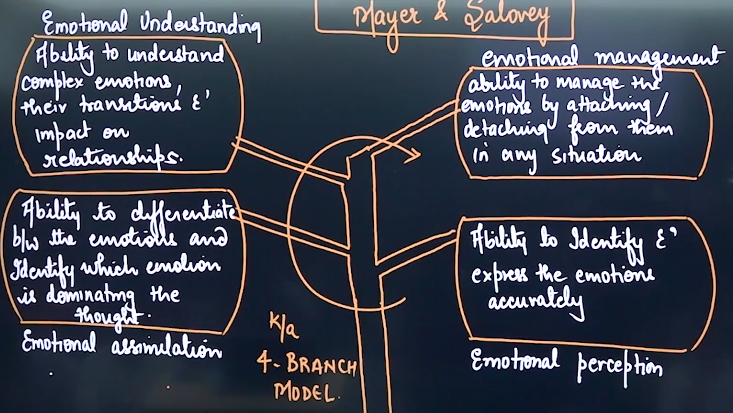
- eg wrt emotional state of Arjun
- able to identify emotions
- aware that sympathy was dominating his thought process
- however, interaction w/ lord krishna made him understand that emotion of sympathy is weak & by not fighting against wrong, he’ll be comitting sin
- hence, detached himself from sympathy and fought for dharma
- became STHITHAPRAGNYA (emotionally stable person)
Can EI be learned?
One school of thought believes genetics & early experience play imp role in how we manage emotions.
However, EI can be learned through following
- Motivation: commitment, conscious effort, willingness to evaluate emotions
- Well designed intervention: help person get accurate feedback abt how others perceive them
- Flexible attitude: early socialization necessary
- Application: deliberate effort to apply teachings in real life
EI in Administration
2 parts:
- Theoretical
- EI in Indian admin
Theoretical bg
- Scientific mgmt by FW Taylor
- Max Weber’s Theory of Power
Scientific mgmt by FW Taylor
- father of scientific mgmt theory
- basis of theory: eliminating time & motion waste
- sole objective: enhance efficiency & maximization of output
- assumptions
- efficiency can be improved by application of scientific methods
- good worker doesn’t initiate action; only follows order
- worker is economic man
- Scientific mgmt has following principles
- one best way of doing a task
- selecting + training workmen
- ensure work done acc. to best way
- Criticism
- mechanistic: ignored human side of organization
- monistic
- oversimplified human motivation only in economic terms
- treated man as mere cog in machine
Max Weber
POWER: Ability of individual to exercise their will in collective action, despite resistance of others.
AUTHORITY: when power is legitimate, it is called authority
3 types of authority:
- Traditional: monarchy, patriarchy
- Charismatic: characteristics of a leader
- Legal-Rational: written rules designed to achieve goals or ends
- a formal organization, constituting adminstrative staff of legal rational authority known as Bureaucracy
According to Mohit Bhattacharya, 2 component of bureaucracy
- Structural component: hierarchy, DoL, rules, roles
- Functional component: objectivity, rationality, rule orientation, impersonality
Weber's Impersonal Management
- defined as mgmt thru system of official authority & predefined rules rather than emotions
- core of weberian bureaucracy
- aim to maximize efficiency
- Demerits
- occupational psychosis: eg. use of IT in bureaucracy
- lack of compassion among officials further aggravates problem of weaker sections
Elton Mayo
Father of Human relations school of thought. Conducted Hawthorne Experiment for efficiency at workplace
Findings of the experiment:
- social & psychological factors rather than phy conditions at work determine efficiency at workplace
- cohesion, supportive supervision, sense of belonging, encouraging peer crucial in motivating employees
- key takeaway: recognizing importance of treating employees as social beings with emotional needs
- within every formal organization, an informal organization determining efficiency of organization by setting rules & patterns of behaviour
- participative mgmt is key because it creates pleasant env & internalization of goals, reduces alienation, increases overall productivity
Work of Elton Mayo carried forward by Daniel Goleman and ‘Mayer & Salovey’.
Role of EI in India Administration
- all governance is people’s governance
- all service is public service
- if we fail to develop trustworthy relationship between citizen & government we cannot good governance
- imp for civil servants to have empathy, compassion, integrity, patience, tolerance
- EI is the sine quo non for good governance
Significance of EI in Civil Services
- EI officials aware of needs of citizens & hence not go for one-size-fits-all approach eg. Bike ambulance by Awanish saran
- EI officials self motivated to achieve public service eg. Operation Suleimani by Prashant Nair
- self aware of responsibilities & not be demotivated due to challenges eg. Armstrong Pame (miracle man of india)
- Shashanka Ala’s initiative “My school my farm”
- regulate emotions, overcome crises of conscience
- eg. Rajni Sekri exposed scam in Haryana
- Poonam Malakondian (Monsanto)
- role model for others by walking the talk
- Ajay Shankar Pandey reaches office 10 mins early to clean his cabin
- Compassion
- S Somvanshi (IAS officer, MP cadre) removed AC from office, got installed in nutritional center. Ppl started donating money, 5L collected
- Persuade ppl, diffuse conflict
- N Prasant, DC, Kozhikode: relocation of street market
Hence, EI officials will ensure development of morally virtuous society & shared vision, prevent status quoism.
Q. In case of a crisis of conscience, does emotional intelligence help to overcome the same without compromising ethics or morals? Critically examine. (UPSC 2021)
EI in Indian Context
- Mention in Bhagwat Gita
- emotionally stable person referred to as Sthithapragnya
- desire & anger are 2 vices
- desire leads to attachment to someone/something
- generates longing
- if not fulfilled => anger
- anger => makes u delusional
- capacity to differentiate b/w right & wrong crippled => downfall eg. Duryodhan, Ravan, Kaikeyi
AS per Gita, Emotionally intelligent ppl have following qualities:
- remains unperturbed in face of calamity
- mind is not shaken by adversity
- takes both good & bad equally
it is thru Nishkama Karma that an individual becomes emotionally stable.
- it is philosophy talking about performing duties w/o any expectations
Significance of NK in CS - anonymity (work w/o expecting rewards)
- result of action should not agitate mind even in tense situation (only when performed with detachment)
- situation not in hands of individual & cannot guarantee desired result
- reduce feeling of relative deprivation
- creates scope of innovation & out of box thinking will have courage to take risk w/o being bothered abt result
- encourage honesty, integrity, quick decision making, easy resolution of dilemma
- unconditional service irrespective of caste, religion, class etc.
Q. Our attitude towards life, other people, and society is shaped by the family and the social surroundings. Some of these acquired attitudes and values are undesirable in a democratic and egalitarian society.
a) Discuss such undesirable values prevalent in today’s educated Indians.
b) How can such an attitude be changed?