Carbon Capture, Utilization & Storage (CCUS)
Union budget allocated Rs.20,000Cr over next 5 years to support development and deployment of CCUS
What is CCUS
IEA defines CCUS as tech that captures form large stationary sources like power plants and industries.
Capture techniques:
- direct air caputre
- solvents (chem/phy)
- adsorption
- cryogenic separation
Storage:
- trapped in geological storage incl. Enhanced oil Recovery, Enhanced Coal Bed Methane Recovery
- permanent storage - saline aquifer, basalt storage
Significance of CCUS for India
- decarbonization of hard to abate sectors
- only known tech for decarbonizing steel, cement, oil & gas, chemical, fertilizer industry
- enabling sunrise sectors to be cost competitive production of blue hydrogen
- CCUS enables circular carbon economy
- allows value added products through usage of captured carbon
- sustenance of existing emitters by retrofitting
- achieving net ero emissions targets
- as 3rd largest emitter of CO2, CCUS imp
Challenges with CCUS
- high cost $100-150B for 750mtpa of CO2
- tech limitations
- CO2 utilization tech less developed
- DAC in early stage & expensive
- difficult to retrofit existing plants
- geological storage risk - fracture rock, induce microearthquake
- regulatory hurdles
- limited data on success of storage of CO2
Way forward for CCUS
- incentivize & derisk CCUS projects to enhance pvt participation
- support low carbon & carbon abated products through preference in public procurement
- targeted policy intervention eg. Carbon Capture Finance Corporation
- promote R&D in novel CO2 utilization tech
- tech transfer from other nations
- mapping storage sites
- hub & cluster model eg. in KG Basin
- Machine learning for Geological data analysis
Transmission Bottleneck
- Temporary General Network Access: provides short term access to interstate transmission system
- India producing lot of energy, incl. clean sources, but weak transmission infra causes losses, curtailment of power generations
Solar Energy
Floating Solar Photovoltaic project
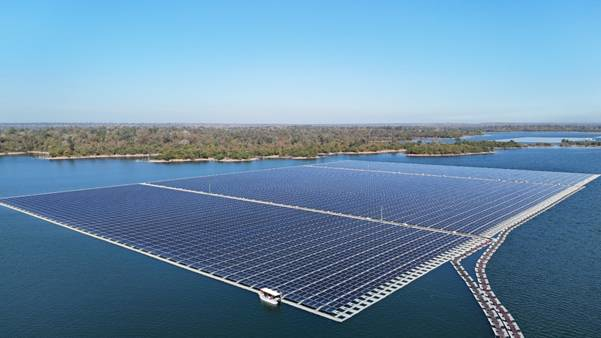
- under PM Surya Sarovar Yojna, outlay of Rs.5070Cr
- goal to deploy 5000MW of FSPV w/ 10,000MWh of BEES
- current estimated india’s floating solar potential:
- 102GW (at 20% surface area utilization)
- current operational floating solar capacity: 700MW
- Omkareshwar Floating Solar Park, MP (278MW operational out of 600MW)
- advantage
- land conservation, no land acquisition litigation, avoid agri land diversion
- preserve freshwater reserves
- colocation with HEP dams
- inhibition of algal blooms
- challenge
- high capital & anchorist cost (15% more than ground mounted plants)
- drastic seasonal change in reservoir water level
- ecological & biodiversity concerns
- corrosion, moisture degradation
- multi agency regulatory bottleneck
Geothermal Energy
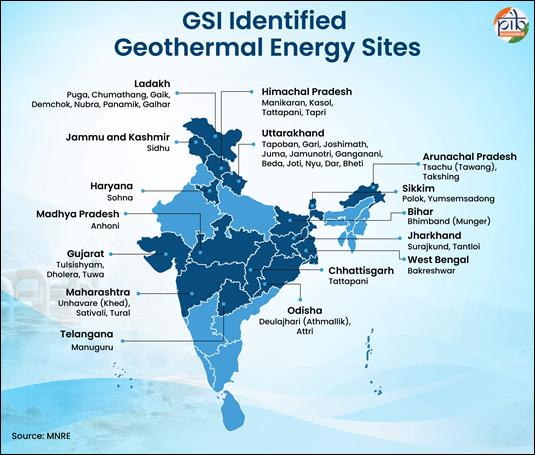
- National Policy on Geothermal Energy 2025
- GSI: india’s geothermal potential at 10.6GW
- Major geothermal provinces
- SONATA (Son-Narmada-Tapi)
- Godavari basin
- Aravalli
- Ladakh - himachal
- Andaman volcanic arc
- Puga Valley project: high altitude, in Ladakh’s Changthang region
- Two 1000 metre wells
- india’s maiden 1MW demonstration scale geothermal power plant
| Location | Org | Status |
|---|---|---|
| Puga Valley, Ladakh | ONGC, Ladakh Admin, LAHDC | 2x 1000M deep production wells commissioned |
| Ankleshwar, Gujarat | MNRE Pilot project w/ Oil & Gas PSU | retrofitting abandoned or depleted oil & gas wells for geothermal poer |
| Gandhinagar, Gujarat | Integrated solar, geothermal | |
| Tawang, Arunachal | High altitude geothermal resource assessment |
Geothermal advantages
- round the clock clean baseload
- unlike weather dependent wind / solar, geothermal can operate at high capacity utilization
- decarbonizing fragile border regions
- direct multi sector applications
- greenhouse farming
- district space heating
- agro processing
- geo tourism
- critical mineral extraction from geothermal brines
- Lithium, Rubidium, Boron
Challenges
- high upfront exploration risk
- high altitude logistical issues, sub zero temp, narrow mountain passes
- corrosion & mineral scaling due to geothermal fluids
- environment & induced seismicity concerns
- absence of mature indigenous supply chain in geothermal tech
Way forward
- derisk private capital via VGF
- fast track multilateral knowledge partnerships eg. with Iceland, Australia, Saudi
- Synergize Hydrocarbon data with geothermal mapping
- to reduce survey costs
- standardize district direct use infra
- enforce closed loop reinjection standards
Conclusion: net zero 2070 goal, 500GW non fossil fuel target