Q. W/ example of a leader, how has he influenced you
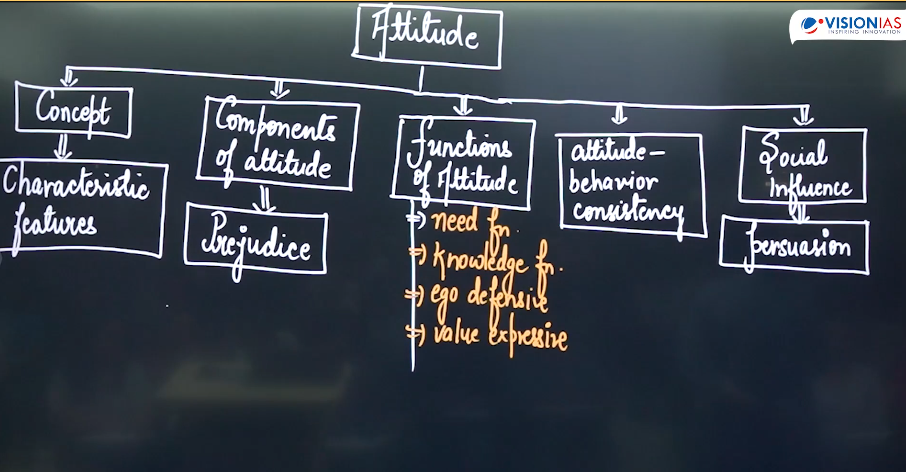
- readiness of psyche to act or react in a situation
- opinion/perspective of attitude holder towards attitude object
- shaped through process of socialization over the years 📆
- never formed in vacuum
- it is a +ve or -ve evaluation of attitude objects
- long lasting
- subjective because depends upon individual
- ambivalent: co-existence of both +ve & -ve attitude simultaneously
- held because they perform some function for individual
- always communicated either verbally or non verbally
- quotations on t shirt
- WhatsApp status
- Insta bio
- conforms to principle of consistency
https://t.me/smritishah_visionias
Components of attitude
components of attitude
Link to original
Prejudice
- Negative attitude towards a particular group
- based on stereotype
- negative stereotype creates prejudice
- often associated w/ emotions of hate & anger
Prejudice may get translated into discrimination. However, behavioral component can be controlled by law.
Throughout the history, there have been neutral examples:
- apartheid in South Africa 🌍
- racial prejudice
- persecution of Jews during Nazi Germany 🇩🇪
- ethnicity
- untouchability in India 🇮🇳
- caste based
- discrimination faced by LGBTQ community 🏳️🌈
- gender identity & sexual orientation
Kalpana Saroj: dalit + woman
Strategies to be adopted to address cognitive and affective component
- Knowing root cause of development of prejudice
- eg. image of Africans in cinema
- prejudice against women (patriarchy)
- Efforts should be made to correct prejudice
- through education, cultural integration
- eg. NE Students
- Bezbaruah Committee: use sports to integrate NE into national discourse
- Facilitate direct communication b/w diff groups
- community lunches to dilute inter caste prejudice
- Discourage -ve behaviour among victims of prejudice which reinforces prejudice
- De-emphasizing narrow social identity based on in-group
- in-group is the group from which one choose their identity
Voltaire
Prejudice is what fools use to reason.
ingroupism
Link to original
There exist various kinds of prejudices in the context of Indian society. Discuss the factors that have resulted in the formation of those prejudices and enumerate the measures that can be taken to correct those prejudices.
Functions of attitude
Acc to Daniel Katz, Attitudes are held as they perform certain functions - eg - need fn, knowledge, ego defensive, value
functions of attitude
Link to original
Need function
- satisfy needs, Utilitarian function
- hence to change attitude, either the need should change or an alternative attitude requires that further serves existing need
Need Function
- X develops a favorable attitude towards risk-taking in their career because it fulfills the need for personal growth, innovation, and desire to achieve higher success levels
- A person might have a strong attitude towards saving money and being financially responsible, as it fulfills the need for security and stability
Knowledge function
- helps to organize and interpret diverse set of info
- Understanding Function
- may not provide factually correct picture
- picture only gives individual power to understand cause of event
- Hence, to change attitude, we need to provide counter attitudinal information sustainably
Example: Knowledge Function
- X has developed an attitude that girls are not good with maths which serves as a framework for understanding the low representation of women in technical fields
Ego defensive
- helps enhance our self esteem & defend ourselves against various arrows of life
- aka prejudiced attitudes which we often use to uplift our self image
- prevents us from acknowledging basic truths about ourselves
- eg.
- blame culture
- domestic violence
- son of soil theory
- can lead to Whataboutism
Example: Ego Defensive Function
- a person might downplay the health risk associated with smoking because acknowledging those risks might threaten their self-image
- Some individuals might deny the severity of climate change because accepting the reality would generate feelings of guilt
Whataboutism
- When someone confronted about their actions or actions of their identifying group, they defend their ego by shifting focus away from their actions
- difficult to change
- because stems from individual’s personality
- we must provide conducive env where individual given unconditional +ve regard & agree to lower their defences
Value expressive function
- helps promote self esteem or exercise impression mgmt
- helps communicate who we are
- and what makes us feel good
- because we are able to express our identity
- can only be changed when either:
- value system itself has changed
- alternative attitude can express existing value better
Example: Value Expressive Function
- If X is an employer and values freedom, he would express his values of loving freedom by encouraging:
- flexible work schedule
- constructive criticism
- ensuring participative management
- Status on social media, quotations on T-shirts, and conduct
Attitude behaviour consistency
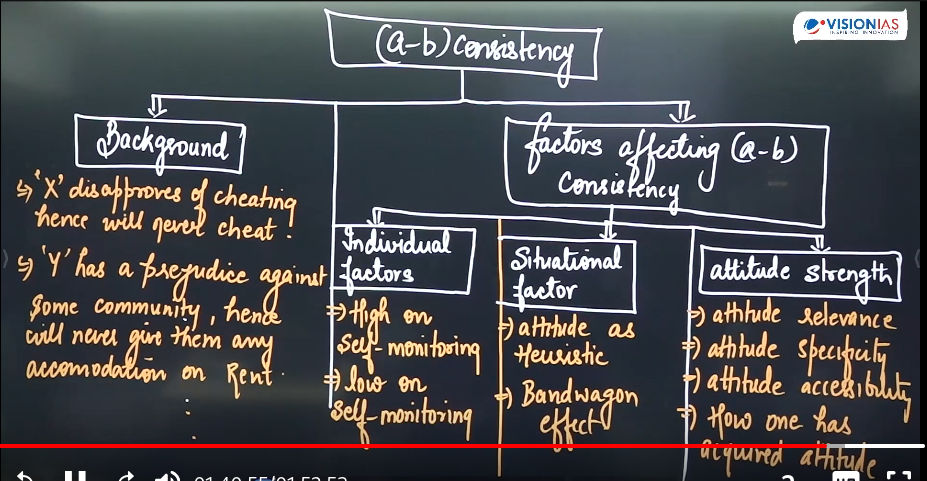
Background
- Corey Study 1937: as per study, concluded that whether a person cheats or not, depends NOT on attitude towards cheating, but on how poorly one has performed in exam
- hence, behaviour may not always be consistent w/ attitude
- Lapierre Study 1934: establish racial bias concerning chinese ppl in USA
- however, concluded that behaviour not always consistent w/ attitude
Factors affecting AB Consistency
Individual
- high on self monitoring
- diff situation, w/ diff ppl, act like diff person
- good at adapting to situation, hence promote interpersonal harmony
- however, many consider them as fake
- low on self monitoring
- behaviour expression of true feeling
- rigid, may not be able to present themself in socially desirable manner
Situational Factor
Attitude as heuristic
- when info overload
- no time to plan or contemplate behaviour
- in such cases we act as per out attitude => high AB Consistency
- eg. brand impact on behaviour
Band wagon effect (herd mentality)
- if we hold a group in high regard and their attitude is different, AB consistency is less, since we adapt our attitude with theirs
- eg. obsession with english language
- voting behaviour
- persistence of social evils
- untouchability
- child marriage
- dowry
Attitude Relevance
- depends on relevance of attitude object for attitude holder
- eg. blood donation and consistency w/ behaviour depends on who requires blood
Attitude Specificity
- specific attitude stronger than general attitude
- eg. when person is religious or how often they visit shrines
- if one prefers cleanliness or one’s opinion regarding construction of household toilets
Attitude acessibility
- the moment attitude holder is exposed to attitude object & if attitude is immediately accessible then it is strong and consistent w/ behaviour
- eg. attitude related to social issues can be +ve, -ve, ambivalent
- ambivalent -> one might enjoy sensation of smoking despite acknowledging it is injurious to health
- X believes reservation strengthens democracy, however also believes its politicization creates conflict
How has one acquired the attitude
- if attitude due to direct exposure to attitude object, then strong
- eg. attitude of victims concerning social evils
What factors affect the formation of a person's attitude toward social problems? In our society, contrasting attitudes are prevalent in many social problems. What contrasting attitudes do you notice about the caste system in our society? How do you explain the existence of these contrasting attitudes? (10 Marks/150 words).
Types of Attitude
- positive or negative
- democratic & bureaucratic
- moral & political
Positive attitude
When attitude of individual such that they always focus on good in other ppl or situations, events, ideas, etc referred to as positive attitude
Characteristic features
- optimistic
- always focus on opportunities rather than challenges eg. Thomas Edison
- problem solving approach eg. Dr. Satish Dhawan
- achieve long term goals since they exhibit values of patience & perseverance eg. Nelson Mandela
- never blame others for misery eg. Sandeep Singh, Arunima Sinha
- never gave up in situations of adversity eg. Mahatma Gandhi
Democratic & Bureaucratic Attitude
| Bureaucratic | Democratic |
|---|---|
| attitude of an individual where basis of decision making is written rules, regulations | attitude such that they encourage participative decision making |
| - rigid - top down / centralized - objectivity - impersonality - rule orientation | - flexilbe - bottom up / decentralized - humanistic orientation - fluid communication - participitative |
| - quick decision making - easy resolution of dilemma - legitimacy - uniformity - lack of bias - less possibility of favoritism - easy to hold accountable - rationality - precedence for future decision making | - ppl focal pt. of decision making - inclusive decision making - better acceptance & internalization of decisions - better evaluation of decisions due to constructive feedback - flexible - grounds for innovation - efficiency |
| - apathy - red tapism - status quoist - blind rationality - over obsession w/ rules to the extent of displacement of goals - one size fits all - policy paralisys - trained incapacity - self alienation / prostitution of personality - transfer of responsibility - crisis of conscience | - time consuming - difficulty in arriving at consensus - uninformed participation - difficulty to hold accountability - “collective interest” might promote elite interest |
- in reality, blend needed
- when framing SOP, one can have bureaucratic attitude, however application be democratic
- in normal course of events, be democratic, but in emergency, be bureucratic
- target audience educated, then democratic, else bureaucratic
Moral Attitude
- attitude of individual which is based on moral conviction wrt right and wrong
Features
- based on righteousness
- denotes our belief about morality
- attitude towards moral lapses
- behaviour when confronted w/ ethical dilemmas
Sources
- moral attitude is shaped through socialization
- imp agencies:
- family
- education
- religion
Features of persons w/ moral attitude
- Reverence
- respectful towards others
- eg. tolerant of dissent, differing opinion
- abiding by provision of constitution
- Faithfulness
- never cheating in any relationship
- professional (bribe)
- personal (infidelity)
- Awareness of responsibility
- citizens aware wrt duty to vote in elections
- parents aware wrt desirable socialization to children
- officers aware to ensure efficient service delivery
- Veracity
- observing the truth
- esp. in backdrop of fake news, paid news, propaganda, post truth era
- POST TRUTH: era or period where ppl opinion shaped not by facts but their belief & emotions
- Goodness
- broadly encompasses character of person consisting of following qualities
- kindness
- generosity
- compassion
- broadly encompasses character of person consisting of following qualities
Political Attitude
- attitude towards political leaders, parties, public issues
- based on political losses & gains
- determines how individuals choose to behave during elections, respond to policy-making
Factors shaping political attitude
- charismatic personality of leader
- ideological proximity
- agencies of socialization
- family
- friends
- work colleagues
- influenced also by media, social media
- policy making, extent to which development is ensured
- according to Rajni Kothari, influenced by 2 factors
- caste
- religion
- class position of individual
- have nots will prefer welfare govt
- demographic factor
- age
- older ppl less open to change
- gender
- role of women increasing
- age
- election manifestos
- inc status of nation on global platform
- security concerns